Choosing a domestic worker is one of the most important decisions a family makes during the recruitment journey. While many employers begin by asking, "Which nationality is the best?", the more useful question is, "Which domestic worker is the best fit for my family's needs?"
Every nationality brings different strengths, experiences, language abilities, and cultural backgrounds. However, no nationality is universally better than another. The right choice depends on your household size, daily routine, children's ages, the type of support you need, and the qualities you value most in a domestic worker.
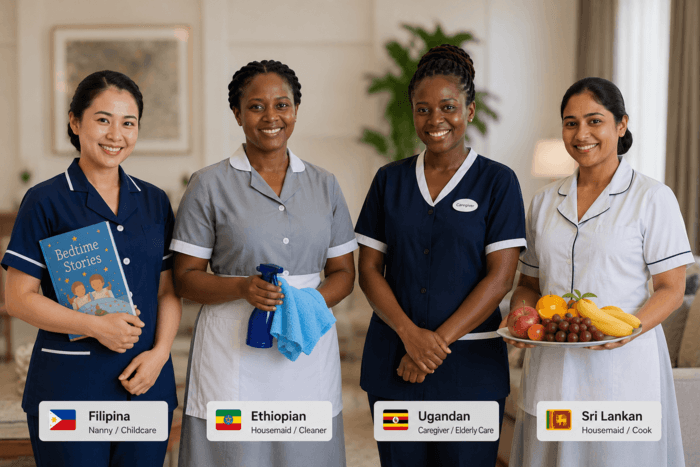
In this guide, we'll compare Filipino, Ethiopian, Ugandan, and Sri Lankan domestic workers, helping you understand the general characteristics often associated with each nationality. More importantly, we'll show you how to choose the right domestic worker based on your family's lifestyle—not simply the country listed on a passport.
📌 Quick Answer: Which Nationality Is Best for Your Home?
There is no single nationality that is best for every family. Some households may benefit from a domestic worker with strong childcare experience, while others may prioritize housekeeping, cooking, communication skills, or flexibility. The smartest approach is to identify your family's needs first and then choose a qualified candidate whose experience, personality, and skills match your expectations.
🏡 Start with Your Family's Needs, Not the Nationality
Many first-time employers begin their search by focusing on nationality alone. While nationality can provide a general idea about language, training, or common experience, it should never be the only deciding factor.
Instead, ask yourself:
- Do you mainly need housekeeping support?
- Will the domestic worker care for young children?
- Is elderly care required?
- Does someone in the home prefer communicating in English?
- Is cooking an important responsibility?
- Does your family follow a structured daily routine?
- Are you looking for previous overseas experience?
Answering these questions first makes it much easier to identify the type of domestic worker who will fit naturally into your household.
💡 Expert Tip
Families who choose a domestic worker based on their actual household needs are usually more satisfied than those who choose based on nationality alone.
📊 Comparing the Four Nationalities at a Glance
Before exploring each nationality in detail, the table below provides a general comparison of the qualities families commonly consider during the recruitment process.
| Feature | 🇪🇹 Ethiopia | 🇵🇭 Philippines | 🇺🇬 Uganda | 🇱🇰 Sri Lanka |
|---|---|---|---|---|
| Housekeeping | ⭐⭐⭐⭐⭐ | ⭐⭐⭐⭐ | ⭐⭐⭐⭐ | ⭐⭐⭐⭐ |
| Childcare | ⭐⭐⭐⭐ | ⭐⭐⭐⭐⭐ | ⭐⭐⭐⭐ | ⭐⭐⭐ |
| English Communication | Basic–Moderate | Excellent | Good | Moderate |
| Adaptability | Excellent | Excellent | Very Good | Good |
| Learning New Routines | Excellent | Excellent | Very Good | Good |
| Household Organization | Excellent | Very Good | Good | Good |
| Experience Levels | Varies by Candidate | Often Extensive | Growing | Varies |
📌 Remember
This comparison reflects common strengths often seen during recruitment, but every domestic worker is unique. Individual experience, training, attitude, and personality will always matter more than nationality alone.
🇪🇹- Ethiopian Maids
Ethiopian domestic workers are among the most popular choices for families across Saudi Arabia. Many employers value their adaptability, strong work ethic, and ability to handle a wide range of household responsibilities. Their willingness to learn and follow family routines makes them a practical choice for homes with different needs and lifestyles.
One of their greatest strengths is their ability to adapt to each household's way of working. Rather than relying on previous habits, many Ethiopian domestic workers quickly learn new routines, respect family preferences, and adjust to individual expectations. This flexibility helps create a smoother working relationship and makes them well suited for families looking for reliable long-term domestic support.
Common strengths often associated with Ethiopian domestic workers include:
- Strong housekeeping abilities.
- Fast adaptation to new environments.
- Willingness to learn household preferences.
- Flexibility with daily routines.
- Good organizational skills.
- Reliable support for general household responsibilities.
⭐ Best suited for:
- Families needing full-time housekeeping support.
- Busy households with daily cleaning responsibilities.
- Families looking for adaptable domestic workers.
- Employers who prefer teaching household routines from the beginning.
🇵🇭- Filipino Maids
Filipino domestic workers are widely recognized for their professionalism, communication skills, and experience in structured household environments. Many have worked abroad before, making them familiar with organized routines and clear instructions.
Their English communication skills are another reason many families choose them. This is especially helpful in multilingual households where clear daily communication is important. Many employers also appreciate their ability to adapt quickly and work confidently within established household routines.
Common strengths often associated with Filipino domestic workers include:
- Strong English communication skills.
- Experience working with children.
- Familiarity with modern household appliances.
- Good organizational and time-management skills.
- Ability to follow structured routines.
- Professional approach to household responsibilities.
⭐ Best suited for:
- Families with young children.
- Households where English communication is important.
- Working parents with structured daily routines.
- Families looking for experienced childcare support alongside housekeeping.
🇺🇬- Ugandan Maids
Ugandan domestic workers have become a popular choice for families looking for reliable household support. Many employers appreciate their calm personalities, positive attitude, and willingness to learn. They are also known for adapting well to different household routines and family preferences.
As with any nationality, experience varies from one candidate to another. However, many Ugandan domestic workers gain confidence quickly as they become familiar with the home, daily routines, and family expectations.
Common strengths often associated with Ugandan domestic workers include:
- Calm and respectful attitude.
- Willingness to learn new routines.
- Good adaptability.
- Reliable support for everyday household tasks.
- Positive interaction with family members.
- Steady improvement through guidance and experience.
⭐ Best suited for:
- Families looking for dependable daily household support.
- First-time employers who prefer gradual training.
- Homes with consistent daily routines.
- Families seeking flexible and adaptable domestic workers.
🇱🇰- Sri Lankan Maids
Sri Lankan domestic workers have been part of the domestic workforce in Gulf countries for many years. Many bring practical household experience and are familiar with a wide range of everyday domestic responsibilities. Their experience varies from one candidate to another, depending on their background and previous employment.
Although availability may change over time, experienced Sri Lankan domestic workers remain a good option for families looking for reliable support with daily household tasks.
Common strengths often associated with Sri Lankan domestic workers include:
- Practical housekeeping experience.
- Familiarity with household routines.
- Reliable support for everyday domestic work.
- Steady work ethic.
- Ability to adapt to family routines over time.
- Experience gained from previous overseas employment in some cases.
⭐ Best suited for:
- Families seeking experienced household assistance.
- Homes with established daily routines.
- Employers looking for dependable long-term support.
🎯 Looking Beyond Nationality: What Really Matters?
Although nationality is often one of the first factors families consider, it should not be the only one. Two domestic workers from the same country can have very different levels of experience, communication skills, and practical abilities.
The best recruitment decisions are based on each candidate's individual qualifications, experience, and suitability for your household, rather than assumptions about nationality alone.
When comparing candidates, pay attention to:
- Previous work experience.
- Training and practical skills.
- Communication ability.
- Personality and attitude.
- Ability to learn new routines.
- Experience with children or elderly care.
- References where available.
- Compatibility with your family's lifestyle.
💡 Expert Tip
A well-matched candidate from any nationality will usually outperform a poorly matched candidate chosen only because of nationality. Skills, attitude, and compatibility remain the strongest predictors of long-term success.
👨👩👧 Which Nationality May Suit Different Types of Families?
Every household has unique priorities, and the ideal domestic worker depends on those priorities rather than a single "best" nationality.
| Family Type | May Prefer |
|---|---|
| Families with infants or young children | Filipino or Ethiopian candidates with childcare experience |
| Busy working couples | Ethiopian, Filipino, or Ugandan candidates with strong housekeeping skills |
| Large homes requiring daily household management | Ethiopian or Ugandan candidates experienced in housekeeping |
| Families where English communication is important | Filipino candidates |
| First-time employers | Any well-trained candidate who demonstrates adaptability, communication skills, and a positive attitude |
This comparison should be viewed as general guidance rather than a fixed rule. Every recruitment decision should be based on the qualifications and suitability of the individual candidate.
❌ Common Myths About Choosing a Domestic Worker's Nationality
When families begin searching for a domestic worker, they often hear advice from friends, relatives, or social media. While some of this advice may come from personal experience, many common beliefs are simply myths that can lead to unrealistic expectations and poor recruitment decisions.
Let's look at some of the most common misconceptions.
Myth 1: One nationality is always better than the others.
No nationality is universally better than another. Every domestic worker is an individual with different skills, experience, training, and personality. Choosing a candidate based solely on nationality may cause you to overlook someone who is a much better match for your family's actual needs.
Myth 2: All domestic workers from the same country have identical skills.
People from the same country do not all share the same background or experience. Some candidates may have years of overseas employment, while others may be starting their first international job. Training, attitude, and willingness to learn often make a much bigger difference than nationality itself.
Myth 3: Experience is less important than nationality.
Previous work experience, practical skills, and the ability to adapt to a new household usually have a greater impact on long-term success than nationality alone. A candidate with the right experience and attitude is often the better choice regardless of where they come from.
Myth 4: Good communication only depends on speaking English.
Communication is about much more than language. Listening carefully, understanding instructions, asking questions when needed, and maintaining respectful interaction all contribute to successful communication inside the home. Many domestic workers quickly improve their communication skills as they become familiar with their employer's routines.
🧩 How to Choose the Right Domestic Worker for Your Family
Instead of asking which nationality is best, ask which candidate best fits your household.
A thoughtful recruitment decision begins with understanding your own family's priorities before reviewing available candidates.
Consider the following questions:
- What are the worker's main responsibilities?
- Is childcare an important part of the role?
- Does your family need cooking experience?
- Will communication in English be beneficial?
- How large is your home?
- Are elderly family members living in the household?
- Do you prefer an experienced worker or someone you can train according to your own routines?
Answering these questions first will make comparing candidates much easier and more objective.
📋 Checklist Before Making Your Decision
Before selecting a domestic worker, review this simple checklist:
- ✔️ Identify your family's daily needs.
- ✔️ Review the candidate's previous experience.
- ✔️ Consider practical skills rather than nationality alone.
- ✔️ Evaluate communication ability.
- ✔️ Ask about childcare or elderly care experience if required.
- ✔️ Choose a licensed recruitment agency.
- ✔️ Complete recruitment through official channels.
- ✔️ Focus on long-term compatibility instead of short-term assumptions.
This structured approach usually leads to a more successful recruitment experience and a stronger long-term working relationship.
📊 Nationality Comparison Summary
| If your priority is... | You may consider... |
|---|---|
| Daily housekeeping and household organization | 🇪🇹 Ethiopian candidates |
| English communication | 🇵🇭 Filipino candidates |
| Childcare experience | 🇵🇭 Filipino or 🇪🇹 Ethiopian candidates |
| Adaptability and willingness to learn | 🇪🇹 Ethiopian or 🇺🇬 Ugandan candidates |
| Calm personality and steady household support | 🇺🇬 Ugandan candidates |
| Practical household experience | 🇱🇰 Sri Lankan candidates |
📌 Remember
These comparisons provide general guidance only. Every domestic worker is unique, and the final decision should always be based on the individual's qualifications, experience, personality, and compatibility with your family's lifestyle.
❓ Frequently Asked Questions
-
Which nationality is the best for housekeeping?
There is no single nationality that is best for housekeeping. The quality of household work depends on the individual's experience, training, practical skills, and ability to adapt to your family's routines. Comparing candidates based on their qualifications rather than nationality alone usually leads to better long-term results.
-
Which nationality is generally preferred for childcare?
Families usually look for candidates with proven childcare experience rather than focusing only on nationality. While Filipino domestic workers are often known for childcare, Ethiopian, Ugandan, and Sri Lankan candidates may also be excellent caregivers depending on their experience, training, and personal skills.
-
Should I choose nationality before reviewing candidates?
It is usually better to identify your household's needs before choosing a nationality. Once you know the type of support you need, you can compare qualified candidates based on their experience, skills, and suitability for your family.
-
Does speaking English always make a domestic worker a better choice?
Not always. English communication can be helpful in some households, but it is only one factor. Experience, reliability, practical skills, attitude, and the ability to follow your family's routines are equally important when choosing the right domestic worker.
-
Is previous overseas experience important?
Previous overseas experience can help a domestic worker adapt more quickly to a new household. However, it should be considered alongside practical skills, training, communication, and overall suitability, rather than being the only deciding factor.
-
Can a recruitment agency help me choose the right nationality?
Yes. A licensed recruitment agency can recommend suitable candidates based on your household's needs, lifestyle, and preferences. By comparing experience, skills, and compatibility across different nationalities, the agency can help you make a more confident recruitment decision.
-
What is the biggest mistake families make when comparing nationalities?
The biggest mistake is judging candidates by nationality alone. A successful long-term placement depends much more on the individual's experience, attitude, communication skills, training, and ability to adapt to your household than on their country of origin.
🤝 Find the Right Domestic Worker for Your Family
Choosing the right domestic worker involves more than selecting a nationality. The best recruitment decisions are based on your family's needs, the candidate's experience, practical skills, and ability to adapt to your household. Taking the time to compare individuals rather than relying on assumptions often leads to better communication, greater stability, and a more successful long-term working relationship.
At Fan Al-Maharah Recruitment, we help families across Saudi Arabia recruit qualified Ethiopian, Filipino, Ugandan, and Sri Lankan domestic workers through Musaned. We take the time to understand your household requirements and recommend candidates who best match your needs. From the initial consultation to the completion of the recruitment process, Contact our team who provides professional guidance to help you hire with confidence and build a successful long-term employment relationship.


